

Kandou AI | When AI Meets Semiconductor Verification to Accelerate Innovation
Kandou AI, an EPFL spin-off specializing in high-speed connectivity, has joined forces with IDIAP to revolutionize semiconductor verification through artificial intelligence. Supported by Alliance’s mentoring, this partnership secured Innosuisse funding to automate the transformation of engineering specifications into formal verification properties.
The Birth of a Beehive
Kandou AI story began around 2010 in ALGO, an EPFL laboratory led by Dr. Amin Shokrollahi. The challenge was straightforward yet critical: processors were becoming exponentially faster, but moving data between chips had become a major bottleneck. The research team explored a novel approach, making multiple electrical signals work together rather than treating each wire independently. This breakthrough led to Chord™ signaling and Chordal Codes, technologies designed to deliver higher data throughput while reducing power consumption, physical connections, and footprint.
Kandou was co-founded in 2011 as an EPFL spin-off by Amin Shokrollahi. The name “Kandou” means “beehive” in Farsi, Amin’s native language. This choice reflects the company’s core philosophy: just as individual bees work together to create something far greater than any single bee could achieve, Kandou’s technology makes multiple signals work together as a system. The name captures the company’s philosophy: intelligent cooperation between individual elements can create a much more powerful system.
The Verification Bottleneck
Despite Kandou’s success in high-speed connectivity, the company faced a universal challenge in semiconductor development: functional verification which consumes more than half of a project’s engineering effort. Translating complex design specifications into SystemVerilog Assertions (SVAs) remains largely manual, requiring scarce specialist expertise and creating risks of errors, late bug discovery, and longer time-to-market.
Existing Electronic Design Automation (EDA) tools can verify properties once they are written but cannot automatically understand complex specifications and derive the required assertions. This gap motivated Kandou to seek solutions beyond conventional semiconductor verification, leading to a collaboration with IDIAP’s Neuro-symbolic AI Group, which brings leading expertise in large language models, symbolic reasoning, auto-formalization, and LLM–solver refinement.
The SPECTRA Project
The Innosuisse SPECTRA project combines Kandou’s semiconductor knowledge with IDIAP’s research to automatically transform engineering specifications—including natural language, tables, and diagrams—into formal verification properties such as SystemVerilog Assertions. The key innovation lies in a multi-agent, neuro-symbolic architecture rather than relying on a large language model alone. Specialized AI agents interpret specifications, identify ambiguities and boundary conditions, generate assertions, and interact with simulation and formal verification tools. Candidate assertions are automatically checked, with errors and counterexamples fed back to the AI for iterative correction.
This creates a closed loop between generative AI and rigorous formal verification. The objective is not simply to generate plausible code, but to produce assertions that are formally checked, traceable to the original specification, and understandable by engineers—reducing manual effort while improving verification coverage, consistency, and product quality.
Alliance Mentoring, a Strategic Partnership
Kandou learned about Alliance through IDIAP. When preparing their Innosuisse proposal for the SME call, the team contacted Robert van Kommer, Alliance’s ICT and AI innovation mentor, relatively close to the submission deadline. Robert van Kommer responded quickly and agreed to support the team. He first reviewed key draft sections of the proposal—Solution, Value Creation, and Risks—providing valuable feedback that the team incorporated before uploading the updated proposal through the Innolink platform. He then conducted a second review of the full pre-final proposal on Innolink, identifying additional areas for improvement and potential issues, and offering practical suggestions to address them before submission.
We greatly appreciated the innovation mentoring service offered by Alliance and Innosuisse. For SMEs, preparing a grant application can be a challenging and resource-intensive process. Having an experienced mentor to provide an independent perspective and practical feedback is a real helping hand.
Navigating Collaborative Challenges
Preparing a collaborative project proposal with a fixed deadline is always challenging, particularly when it involves several people and partner institutions with different priorities and schedules. In Kandou’s case, the collaboration with IDIAP was very smooth and well-organized. The main challenge was managing the timing of the final review by both partners and ensuring everyone’s input could be incorporated before the submission deadline.
Thanks to effective coordination and Robert van Kommer’s timely support, the team successfully navigated these challenges. The proposal was submitted with strengthened content and improved quality, ultimately securing Innosuisse funding.
Looking Ahead
The Innosuisse SPECTRA project with IDIAP is progressing well and remains on track with the original project plan. Kandou’s next major milestone is preparing the first interim report for Innosuisse, due at the end of 2026. Meanwhile, the technical work and collaboration with IDIAP carry on toward achieving the project’s objectives.
This project exemplifies how strategic partnerships between industry and research institutions, supported by Alliance and public funding, can tackle complex technological challenges. For Kandou, it represents another step in their mission to push the boundaries of semiconductor technology, this time by harnessing AI to accelerate the very process of chip development.
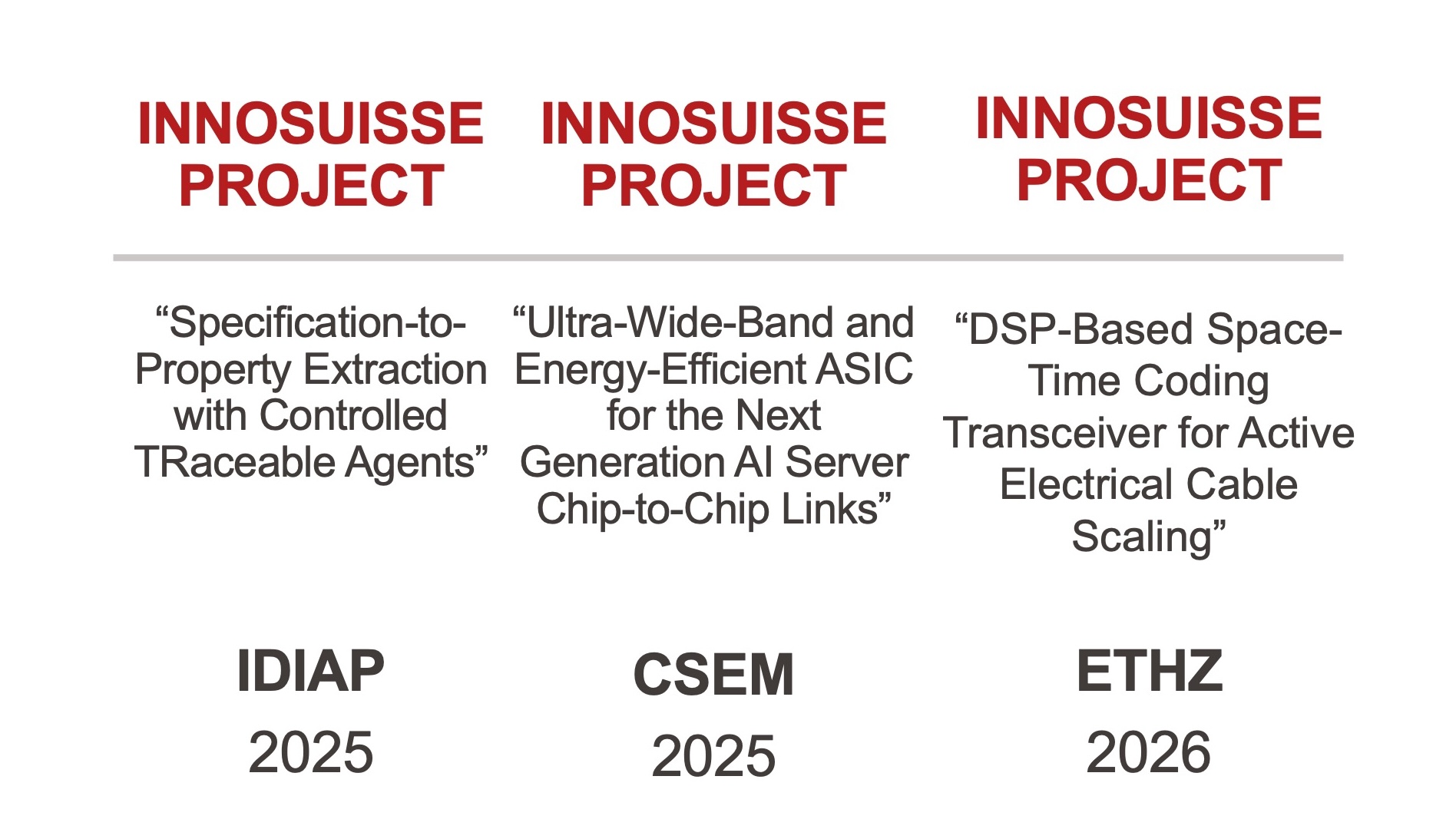
In addition to the SPECTRA project, Kandou has recently secured funding for two other Innosuisse projects in collaboration with academic partners CSEM and ETHZ. All three applications were developed with the support of Alliance & Innosuisse through the innovation mentorship program.
Kandou in brief
Foundation: 2011 (12 January)
Headquarters: St-Sulpice (EPFL Innovation Park), Switzerland
Team: 186 people
Website: kandou.ai
Pauline Calarnou, 26 Octobre 2026.